
The Immortals (written for Inception)
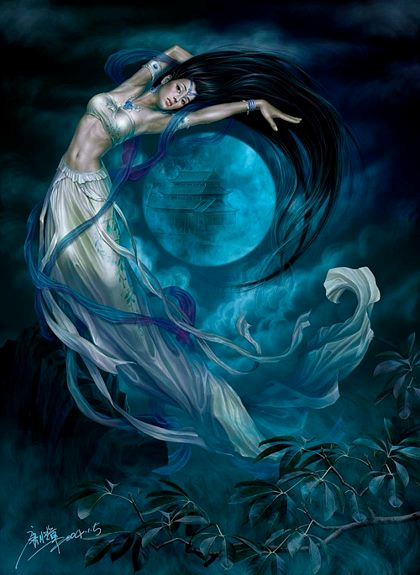
The Immortals
by Pixi
Storm Constantine's fallen angel (Grigori) trilogy is an outstanding example of how to take an archaic legend and mould it into a sophisticated composition in order to shine brilliancy onto its ancient sources. After reading only the first book in the series, Stalking Tender Prey, I became lost in an atmosphere of mystery and beauty, a world haunted by the flickering of ancient shadows.
The legend of the Watchers stimulates the deepest instinctual levels of humanity, the place where dreams arise. It is here, hidden in the misty depths of the soul, they silently await the moment of emergence, to enter into the heart of consciousness and declare their reality. Do these immortals have the ability to materialize through our human senses? Can their essence be made manifest in flesh?
In the aforementioned novel, there is much information available regarding their characteristic attributes. Although they could be described as having human form, they are set apart by their elongated features, high foreheads, sharp cheekbones, well shaped lips, and their bright piercing eyes. Their uncommon appearance together with the ever present atmosphere of the supernatural surrounding them, marked them out as immortals dwelling amidst mortal humanity.
It is said that over the course of time, they took unto themselves human wives who bore children with the same accentuated features as their angelic fathers.
And this could be so, for we find many accounts scattered throughout history giving reference to "unusual" beings, both male and female, who could indeed be of Nefilim origin. Their names live on and have resonance, their signatures have not been erased despite the great divisions of Earth time; and their magnetism is such, that even today, after the passing of centuries, they continue to seduce and entice us into their mystery.
Akenaton (Pharaoh Amenhotep IV, who changed his own name, also known as Akhenaton) was such a one. He walked among us for a while and influenced many lives. A great Pharaoh who shone singularly and brilliantly in the constellation of humanity for a poignant stage in unfolding time, forging unprecedented trails in all avenues of living.
His remarkable physical appearance set him apart from the masses -- some statues of him portray his as being almost asexual -- and revolutionized the religious beliefs of his age. It's not hard to imagine him, eyes ablaze with the passion of his creativity, channeling his uniqueness into establishing his beloved Aton as sole deity -- a God who he describes as being "'the mother and father of all I have done."
Did Akhenaton worship an androgynous God? If he did, then it would explain why he sanctioned his statues to portray him in an asexual manner. It's as if he knew that the merging of the male and female energies within himself would furnish him with a more finely tuned nervous system, indicative of the Great Androgene.
Akhenaton decide to build his "City on the Horizon" far away from the idolatry of Thebes. This exodus led to extreme and violent disorder, incited by the Temple Priest's of Amun who, due to the Pharaoh's light ascending, were fast losing power and wealth. And so, they set about plotting his murder.
The heart of his flower was never allowed to reveal itself by unfolding into fullness; his vision was too far reaching for the masses to comprehend, and like Christ, who came after him, his Gospel of Light was prematurely given over to ignorance, misunderstanding, and was branded the "Doctrine of the Heretic."
The last words of this great Pharaoh are worth a mention: "The Kingdom of the Eternal has no place on Earth. All will return to the old ways. Fear, hatred and injustice will govern the world once more and men will toil and suffer again as they used to do. It were better that I had never been born than I should live to see the triumph of evil."
Akhenaton was a soul of fire, who perhaps held the secrets of immortality, but so much was destroyed, left to fall into dust,it is unlikely we will ever truly know.
Another enigmatic individual, who was the colour amidst a sea of grey, lived a tempestuous existence in Russia.
On January the 23rd, 1871, mankind witnessed a giant meteor scorching a flaming path across the blackened skies of Western Siberia. The wise men of the day believed such phenomena to foretell of some momentous event, which perhaps indeed was the case. For the arching movement of the stellar body swept downward over the tiny village of Pokrovskoye, its substance burning away before it could impact the Earth. And it was at this precise moment that a seven-pound boy child was birthed by Anna Egorovina, the wife of Elfim Akovlevich Rasputin.
That child was Grigori Efimovich Rasputin.
At the tender age of fourteen he knew himself to be a "Son of God," and one day, whilst meditating in a quiet spot under the shade of a tall larch tree, he suddenly became aware of the stirrings of third eye activity. From thereon, his healing and visionary powers began gaining in strength, and by the time he was eighteen years old, his mystical talents had flowered from bud to blossom.
History tells us that Grigori Rasputin radiated immense power. His eyes were intensely blue and shining with the secrets of some profound wisdom; he also possessed an unimaginable magnetism that drew the hearts and minds of the masses.
But his own mind had wings that could soar far beyond the limits of sensory impression, and it ascended far into the star kingdoms where the angels dwell. Naturally, such a light could not escape unnoticed, and before long his company was sought by princes, aristocrats, and the merely curious alike.
The exact date of Rasputin's meeting with the Russian royal family is unclear, but it is most likely to have occurred late October 1905, for on the 1st of November, that same year, there is a recording in the Tsar's diary which reads "We have met a man of God -- Grigori Efimovich, from Tobolsk Province."
Approximately three years after the initial meeting, the Tsar and Tsarina's son became ill, Rasputin was sent for, and was seen, before witnesses, to cure the sick child. From that day forward Grigori Efimovich Rasputin was elevated -- enhanced. He would become an essential element in the lives of the royal couple and that of their beloved son.
And so, as it was with Akhenaton, so it would be with Rasputin. The vipers began gathering en masse in order to plot his assassination; they intended to rid themselves of his eclipsing presence -- permanently.
After the death of this unique man, a tapestry of lies and deceit were woven which would veil Rasputin's true essence. They birthed myths and legends depicting him as evil and macabre in order to cover up the brutal and debase manner in which he was murdered.
In the spring of 1968 whilst researching for her novel, Rasputin, Pattie Barham received a strange phone call that led to a secret meeting with a woman of extreme age. She describes the old lady as being bedridden, and her wrinkled face was framed by a halo of fine white hair. Hanging on the wall in the room where she lay, with two white candles at either side beneath it -- reminiscent of a shrine -- was an enlarged picture of Rasputin.
Through a translator, the writer was informed that the old lady wanted to make it clear that she saw Father Grigori as a great man, as a reincarnation of the Christ. Further discussion revealed that the woman was a Russian aristocrat who, because she was a known disciple of Rasputin's, had fled her homeland and come to live in Paris because she had been afraid for her life. At the time of the interview, the woman was very close to death, but she agreed to it because she wanted people to know that, someone who long ago had walked and talked with Father Grigori, regarded him as the Messiah.
The two men I have discussed in this article were exceptional individuals who emanated a "something" which could reach out in a curious way, to touch and challenge the core of a civilization, and from that challenge, seek to draw out some new creation. Each of them introduced new concepts of a provocative nature to limited minds and the scales of love and hate tipped the wrong way.
In the final paragraph of the "Grigori Cometh" section of Stalking Tender Prey, it reads "Yet so many go unseen now, their past features lost through the many generations since the demise of their culture. Some recognize their origins only through dreams and visions, while others simply want to forget their forbidden heritage. Some, as you might say, have become almost human."
The fallen angels are involved with us on the deepest of levels, where the strands of imagination and reality are intertwined; and I feel a powerful sense of their presence all around me.
About the Author:
Pixi lives in the U.K. You can email her at pixi209@yahoo.co.uk..or shekina010@gmail.com